

Scientists suspect an ice-rock avalanche in Lende Khola triggered Nepal’s deadly Rasuwa flood. The probe now centres on whether an upstream blockage could unleash a second surge.
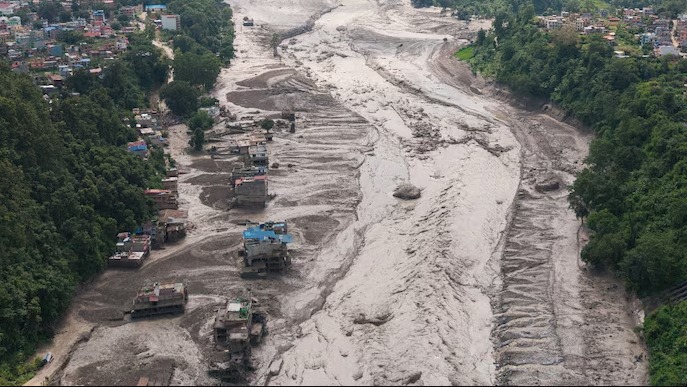
A suspected ice-rock avalanche high in the Himalayas may have unleashed the devastating flash flood that tore through Nepal’s Rasuwa district on August 26, sending a wall of water, debris and boulders racing through the Bhote Koshi and Trishuli river systems.At least 133 Indians are among more than 750 people reported missing, while 157 deaths have been confirmed, after massive flash floods swept through Nepal’s northern Rasuwa district near the Tibet border on Wednesday.
The sudden surge of water washed away homes, vehicles, bridges and infrastructure project sites, leaving widespread destruction in its wake.
The scale and speed of the flood were extraordinary.
WHAT IS THE LATEST FINDING?
Hydrological observations show that water levels on the Trishuli River at Galchchi rose by as much as nine metres in just 30 minutes, while Malekhu recorded a rise of around seven metres over a similar period.Such a rapid surge points to a sudden release of an enormous volume of water rather than a conventional monsoon flood.
Scientists at the Kathmandu-based International Centre for Integrated Mountain Development (ICIMOD), along with partner institutions in Nepal and China, are now investigating whether an avalanche involving ice and rock was the trigger.
According to preliminary assessments based on video footage and information from affected areas, a large mass of ice and rock debris may have crashed into the Lende Khola, a tributary of the Bhote Koshi River. The impact could have displaced water and generated a powerful debris-laden surge, carrying sediment and massive boulders downstream.
Water levels in the Bhote Koshi basin reportedly began rising rapidly around 9 am local time. The flood soon breached riverbanks and surged downstream into the Trishuli River, threatening communities further south in Nuwakot and Dhading districts.
“This tragic disaster struck so suddenly and unexpectedly,” said Pema Gyamtsho, Director General of ICIMOD, expressing solidarity with the people and government of Nepal.
But scientists are also investigating a second and potentially dangerous possibility. The avalanche debris may have temporarily blocked the river at a narrow section, creating what is known as a landslide dam. Water can rapidly accumulate behind such a blockage before suddenly bursting through, unleashing another catastrophic flood downstream.The same site devastated by last year’s Rasuwa flood is once again under threat,” said Qianggong Zhang, Head of Climate and Environmental Risks at ICIMOD. He said an ice avalanche in the Lhende Khola was the suspected trigger, though the cause has not yet been confirmed.
Authorities have warned that a blockage may remain upstream near the Nepal-China border, raising fears of a secondary flood. Evacuation orders have reportedly been issued around Jilong port as scientists assess the stability of the obstruction
DID AN EARTHQUAKE TRIGGER NEPAL FLOOD FURY?
Seismic data is also providing important clues.
A seismometer in Jilong, around 12 kilometres from the affected area, detected unusual signals during the disaster, while another station in Zhangmu recorded anomalous activity. Scientists are examining whether these signals were produced by the suspected avalanche, though no direct causal link has yet been established.The disaster highlights the growing danger of cryosphere hazards in the rapidly changing Himalayas. Melting glaciers, unstable slopes, expanding glacial lakes and thawing ice are creating new risks across the world’s highest mountain range.
